
Auto-Tune
What is Auto-Tune
Section titled “What is Auto-Tune”Auto-Tune automatically monitors your live experiments and surfaces recommendations to improve performance, without taking control away from you. As traffic accumulates, Auto-Tune evaluates each variant against your key metric. Once a variant reaches 1,000 sends, auto-tune checks for statistical significance, identifying both outperforming and underperforming variants and recommending next steps when meaningful patterns emerge.
Step 1: Receive an Auto-Tune notification
Section titled “Step 1: Receive an Auto-Tune notification”Auto-Tune begins from an experiment that is already running.
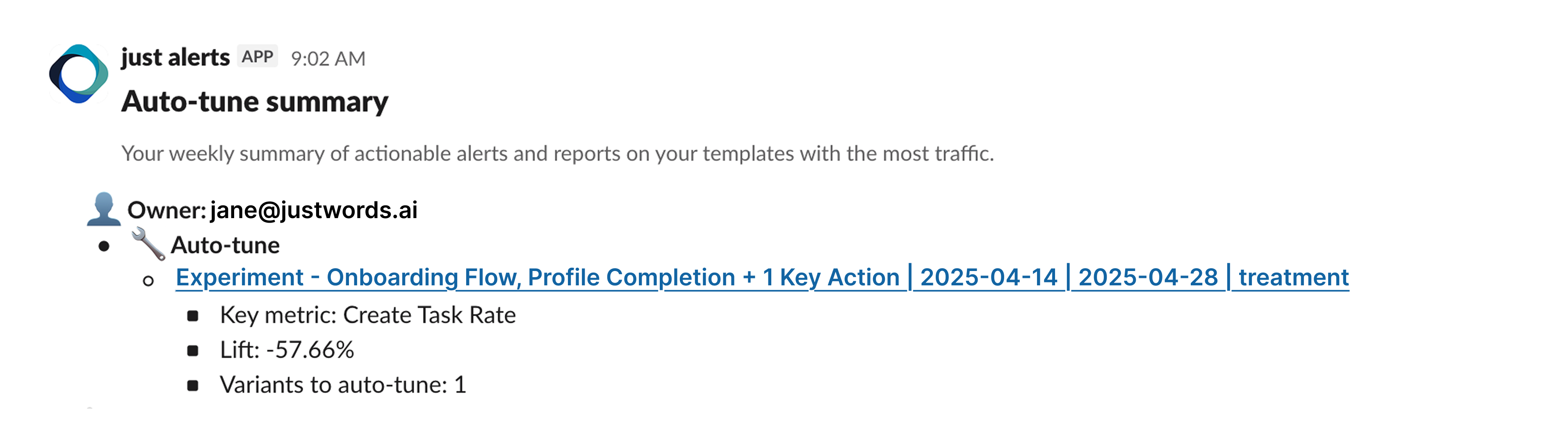
- You receive a Slack notification from an existing experiment that is eligible for auto-tune.
- The notification summarizes:
- Which experiment is running
- The key metric being evaluated
- Whether variants are over- or under-performing
- The notification summarizes:
- Click the notification to view more details.
- This takes you directly to the experiment in Compact Mode in Studio.
At this stage, no changes have been made yet. Auto-Tune is simply surfacing actionable insight from a live experiment.
Step 2: Review experiment performance in Compact Mode
Section titled “Step 2: Review experiment performance in Compact Mode”Once in Compact Mode, you can quickly understand how the experiment is performing so far.
In this view, you’ll see:
- The test that is currently running
- The control and active variants
- Which variants are outperforming
- Which variants are underperforming
- Why certain variants are eligible for auto-tune actions
This summarized view allows you to assess performance at a glance and understand what auto-tune is recommending before any tuning occurs.
Step 3: Address underperforming variants
Section titled “Step 3: Address underperforming variants”Once you’re reviewing results, auto-tune flags variants that are trending down and may be hurting overall performance.
Underperformers are flagged
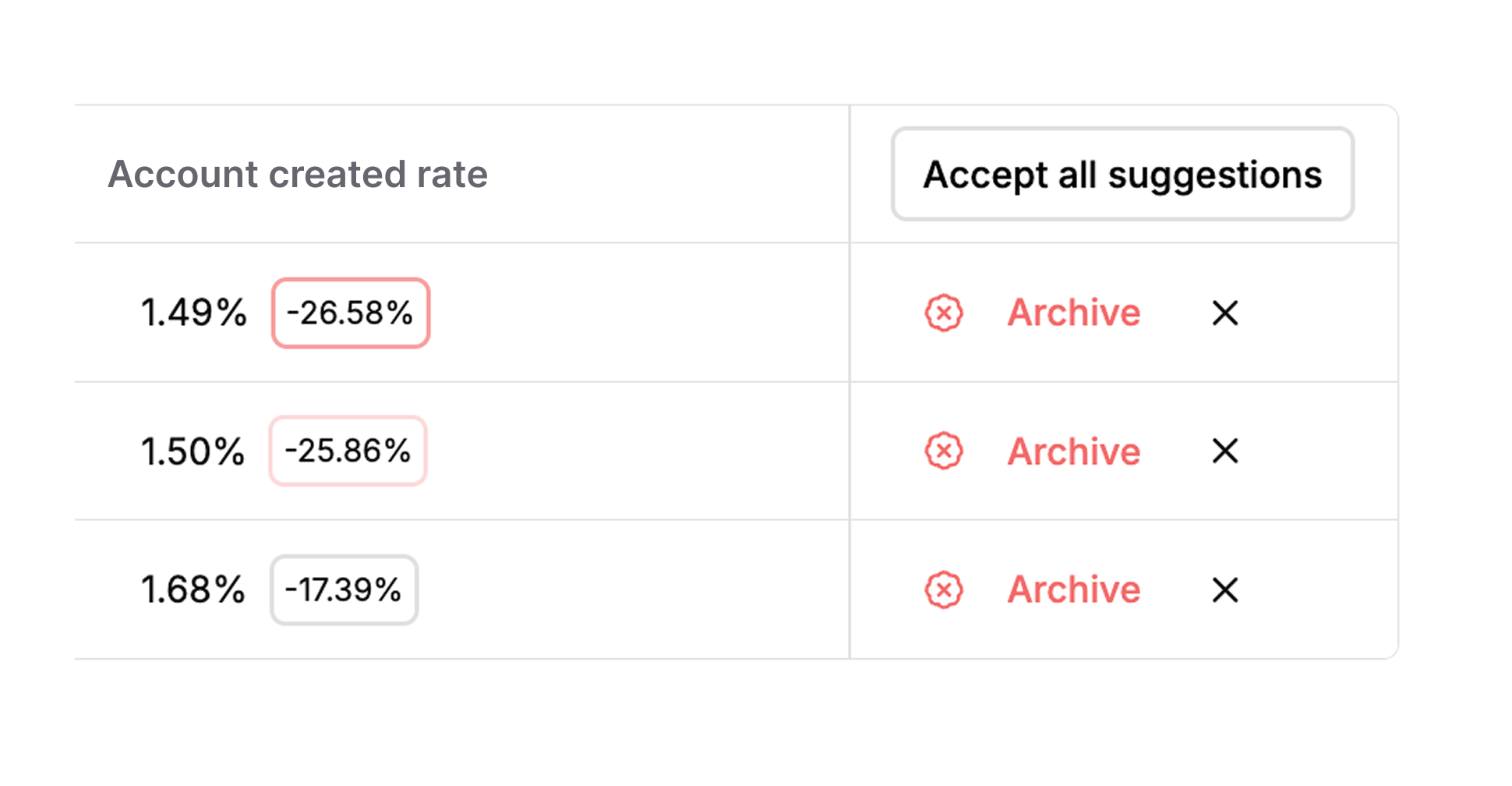
Section titled “Underperformers are flagged”- Underperforming variants are highlighted with a red “Archive” button
- This indicates auto-tune recommends removing the variant from active traffic
What happens when a variant is archived:
- If other approved variants are available, they continue running
- If no other variants are available, the control is shown instead
- This can slow down testing and may interfere with results
To maintain momentum and avoid interruptions, it’s important to keep at least one approved variant running at all times.
Step 4: Review and approve new variants
Section titled “Step 4: Review and approve new variants”To ensure learning continues, auto-tune suggests new variants when needed.
New variants are suggested
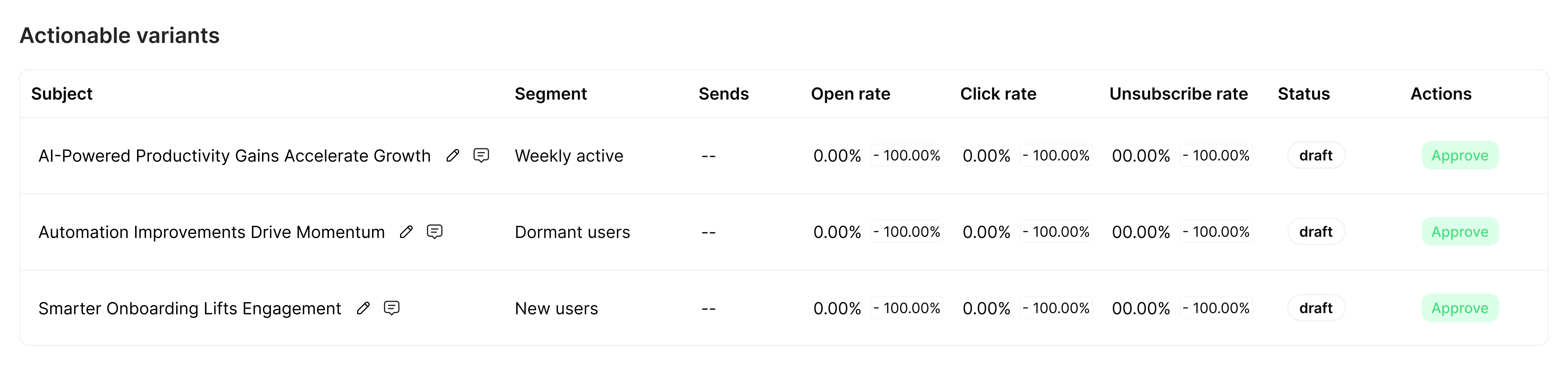
Section titled “New variants are suggested”- Auto-Tune generates draft variants based on successful patterns from your past tests
- Auto-Tune first checks whether you already have active variants that still need more traffic before it creates more drafts
- These variants:
- Are clearly labeled Auto-generated
- Appear with a green “Approve” button
- Are never published automatically
Nothing goes live without your review.
Approving new variants allows auto-tune to keep testing without disruption and continue optimizing toward better performance.
When Auto-Tune creates fewer new drafts
Section titled “When Auto-Tune creates fewer new drafts”Auto-Tune separates two decisions:
- Archive recommendations: underperforming variants can still be flagged for archive once they have enough data.
- Replacement generation: new draft variants are generated only when the experiment needs more replacement candidates.
If there are already active variants that have not reached the minimum sample size yet, Auto-Tune counts those variants toward the replacement need instead of creating the same number of new drafts. This keeps the creative queue focused and gives recently approved variants time to gather traffic.
For templates with audience attributes, Auto-Tune does this per exact attribute combination. For example, an under-exposed country = US variant reduces replacement generation for other country = US variants, but it does not block replacement generation for country = CA.
In short:
new drafts to generate = underperforming variants recommended for archive - active variants below the minimum sample sizeUnder-exposed active variants reduce only the number of new drafts. They do not hide archive recommendations for poor performers.
Step 5: Continuous optimization over time
Section titled “Step 5: Continuous optimization over time”After you’ve reviewed and approved variants, auto-tune continues working in the background.
Over time, this means:
- Your content improves automatically as performance signals accumulate
- Testing maintains momentum and optimizes results in real time
- If performance declines due to fatigue, seasonality, or temporal effects, auto-tune detects it and responds
- You don’t need to manually audit older campaigns, every message stays evergreen, modern, and continuously optimized
Auto-Tune creates an always-on optimization loop, ensuring your content stays relevant and performant without constant manual oversight.